OPC UA Introduction
OPC UA Communication Interface
The Open Platform Communications Unified Architecture (OPC UA) is a standardized, platform-independent communication standard that enables data exchange between devices, machines and software applications. It was published by the OPC Foundation in 2008 with the first official version. OPC UA supports modern communication protocols, high security standards, platform independence, scalability and flexibility. Another key factor is manufacturer independence, which enables OPC UA to facilitate communication between different manufacturers. This is crucial for networked production and industrial automation, thus the industry 4.0 standard.
Overview
Modern industrial environments rely on the integration of heterogeneous systems, often comprising both legacy and contemporary control units, sensors, and machines. Bridging the gap between incompatible communication technologies is critical for effective monitoring and control. OPC (Open Platform Communications) provides a unified language that enables seamless data exchange between devices, automation systems, databases, and software solutions, regardless of the underlying hardware or protocol.
Historical Context and Evolution
OPC Classic (1996): Originally developed to standardize multi-vendor device connectivity. While it established a secure framework, it was built on Windows COM/DCOM technology and was strictly limited to Windows-based environments.
OPC UA (2006): To address platform dependency and modern security requirements, the OPC Foundation introduced Unified Architecture (UA). This evolution is platform-independent, offers enhanced reliability, and facilitates secure industrial communication across all operating systems.
DEWETRON Implementation
Starting with OXYGEN 8.1, DEWETRON high-accuracy measurement systems natively support the OPC UA standard. This allows for flexible network integration in two primary modes:
OPC UA Server: Publishing high-accuracy measurement data to the network.
OPC UA Client: Receiving data from external devices and third-party systems.
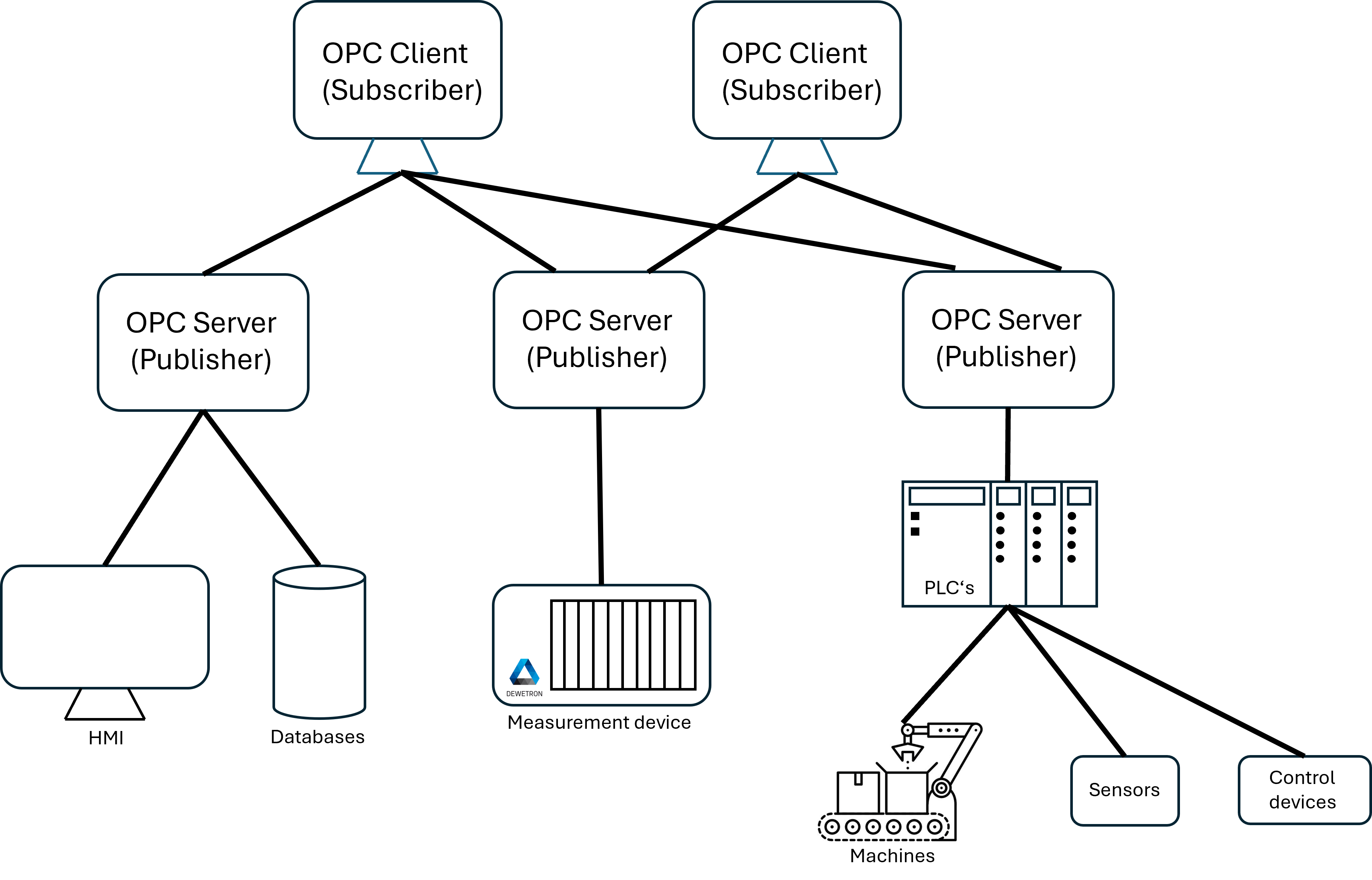
Fig. 1 OPC UA schematic